
 4.0 PRObattery · on the go
 Home 230Vfor home
 Baby food warmersfrom 6 months
 Night Stationfor the night




 Cleaning Wipes Monthly Pack
 Home & 2Go Bundle
 Formula Dispenser Avent
 Baby Bottle Bundle










Beet Puree with Spelt for Babies
Beet Puree with Spelt for Babies: A Fresh Serving, Step by Step, with Video. Related topics: When is it okay to eat beets? Gluten in spelt, nitrates, and red stools.
Contents
In short
To make this beetroot puree, cook 100 g of beets until tender, about 20 minutes, drain the cooking water, and puree them with cooked spelt semolina and canola oil. Beets are high in nitrates: They’re okay to give occasionally once you start introducing solid foods, and according to the BLV, they’re less of a concern starting at 7 months. Serve the porridge fresh; do not keep it warm or reheat it. Spelt contains gluten.
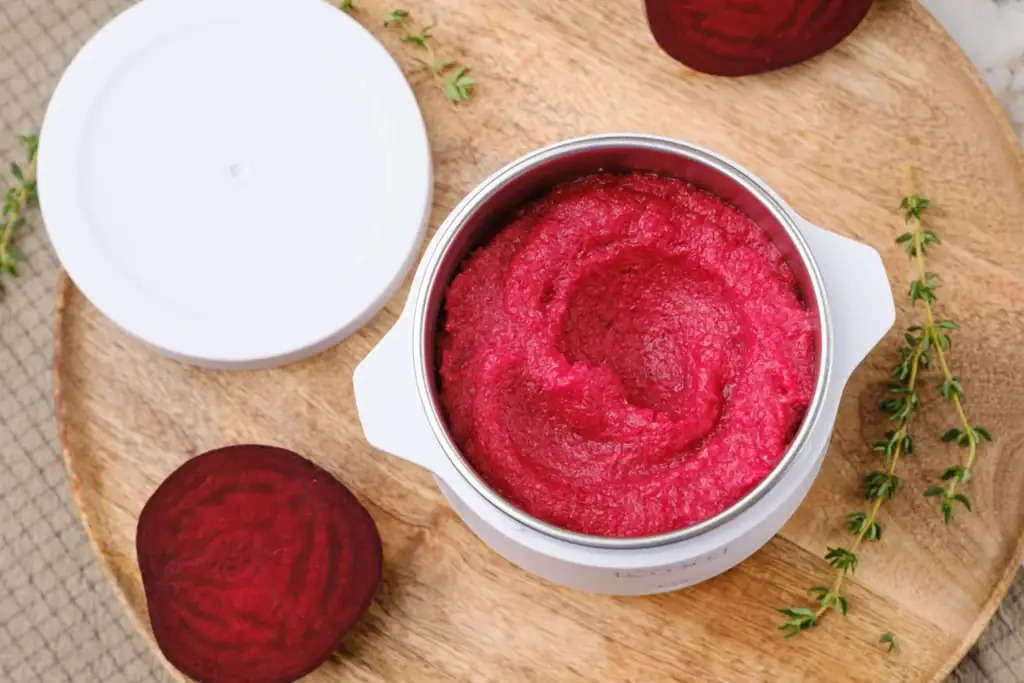
Beets, known in Germany as “Rote Bete” or “Rote Beete,” turn the porridge a bright red and have a slightly sweet taste. When combined with spelt semolina, this makes a vegetable-grain porridge based on the FSVO’s basic recipe: a simple recipe for beets for babies.
Recipe: Beet and Spelt Porridge
- Age: preferably starting at 7 months
- Amount: 1 serving
- Prep time: 10 minutes
- Cooking time: 25 minutes
- Freezing: Not recommended; eat fresh
Ingredients for 1 serving
- 100 g raw beets (1 small beet), organic if possible
- 10–15 g spelt semolina (1–1½ tbsp)
- 80 ml water for the semolina (a little over 5 tablespoons)
- 1–2 teaspoons of canola oil (5–10 ml)
- 300 ml water for cooking the beets (to be discarded)
Preparation
- Get ready. Wash your hands. Wash the beets under running water, then peel them—preferably with gloves, because the juice stains easily. Cut them into cubes about 1 cm in size.
- Cooking Beets: Bring 300 ml of water to a boil in a small pan (saucepan). Cook the cubes, covered, for about 20 minutes, until tender.
- Cooking Semolina: In a second pan, bring 80 ml of fresh water to a boil. Stir in the spelt semolina and let it simmer for about 5 minutes, stirring constantly, until it’s soft.
- Drain the cooking water. Drain the beets. According to the BLV, you should not reuse the cooking water when preparing vegetables high in nitrates.
- Puree: Add the beets to the semolina porridge and puree everything until smooth. If the porridge is too thick, stir in 1–2 tablespoons of fresh water.
- Stir in the oil and serve right away. Stir in the canola oil, let the porridge cool briefly, and check the temperature with a spoon of your own. Feed them right away and throw away any leftovers.

When can your baby start eating beets? Age and Consistency
According to the Federal Office for Food Safety and Veterinary Affairs (BLV), you should start introducing solid foods no earlier than the beginning of the 5th month and no later than the beginning of the 7th month. The guide “Solid Foods: When and How to Start” explains the signs of readiness.
Nitrate: According to the BLV, beets—like fennel, kohlrabi, spinach, and Swiss chard—are among the vegetables high in nitrate. Nitrate can be converted into nitrite, which can impair oxygen supply in infants, especially during the first few months of life. Are you starting in the 5. or At 6 months, low-nitrate vegetables such as carrots, squash, or broccoli are better suited for a baby’s first spoonfuls—for example, in a squash puree with rice. According to the BLV, there is generally no reason to avoid beets; starting in the 7th month, they are less of a concern.
Gluten: According to the German Federal Institute for Risk Assessment (BfR), spelt is a type of wheat and contains gluten. You don’t need to delay introducing gluten: Pediatrics Switzerland recommends introducing gluten-containing grains as part of complementary feeding between the 5th and 7th month of life. If there is a history of celiac disease in your family, talk to your pediatrician about getting started.
Consistency: Start by pureeing the food until it’s smooth; as the baby gets older, the puree can be coarser, according to the BLV. “Eating Right from the Start,” a guide from Austria, recommends coarsely pureed vegetables for ages 6 to 9 months and diced or chopped vegetables for ages 9 to 12 months. According to the Swiss Society for Nutrition (SGE), soft-cooked beetroot cubes can be served as finger food—even fresh—starting no earlier than the 7th month.
Tips and Variations for Beet Puree
- Smart Shopping: According to the BLV, organic vegetables contain less nitrate than conventional ones, while greenhouse vegetables contain more than seasonal outdoor-grown vegetables. Store the beets in a cool, dark place for a short time.
- No additives: According to the BLV, you should leave out salt, bouillon, and spices.
- Start small: If your baby is only eating a few spoonfuls, cook half the amount.
Good to Know
According to the German Federal Institute for Public Health (BIÖG), your baby’s stool may turn reddish after eating beets, and according to the British National Health Service (NHS), their urine may turn pink. If your baby’s stool is red even though they haven’t eaten beets, or if you’re unsure, ask your pediatrician.
Variants:
- Gluten-free: Instead of spelt semolina, use millet or corn semolina. According to IG Zöliakie, millet, corn, and rice are gluten-free. For a strictly gluten-free diet, choose products labeled as gluten-free.
- Using potatoes instead of semolina: According to the BLV, 10–15 g of semolina is equivalent to 50 g of potatoes. Cook the diced potatoes together with the beets, then mash them with 3–4 tablespoons of fresh water.
- With meat or fish: Cook 10 g of lean meat (about 2 tsp), cut into small pieces, according to the BLV and SGE, starting no later than the 7th month, from the 9 through 10th month: 20 g, according to the SGE. Or, according to the BLV, use the same amount of boneless salmon fillet. Cook thoroughly.
- With apple: Stir in 3–4 tablespoons of applesauce or finely grated apple. “A Healthy Start to Life” recommends adding fruit juice or fruit puree to vegetarian porridge, because more fruit juice increases the absorption of iron from grains and vegetables.
Eat fresh: do not store, do not freeze
You shouldn’t cook beetroot puree in advance: According to the BLV, your baby should eat this nitrate-rich vegetable immediately after it’s prepared, without keeping it warm or reheating it.
Attention
Therefore, do not put beetroot puree in the refrigerator to save for later, do not freeze it, and do not take it with you in a food warmer or insulated container, because all of that would mean having to reheat it later. Don’t cook it until your baby is awake and hungry.
For outings, a puree made with low-nitrate vegetables—such as carrot puree with apple—is a good choice. Cool it down quickly, take it with you once it’s chilled, and reheat it once you get there—see ” How to Keep Porridge Warm on the Go.” For instructions on how to prepare and freeze other types of baby food, see ” Making Your Own Baby Food.”
Frequently Asked Questions
When can my baby start eating beets?
Once you start introducing solid foods, you can add beets to the porridge every now and then—that is, no earlier than the beginning of the 5th month. Because beets contain a lot of nitrate, the BLV recommends low-nitrate vegetables such as carrots or squash for a baby’s first spoonfuls. According to the BLV, beets are less of a concern starting in the 7th month.
Does spelt contain gluten?
Yes. According to the BfR, spelt is a type of wheat and contains gluten. Pediatrics Switzerland recommends introducing gluten-containing grains between the 5th and 7th month of life. If your child needs to eat gluten-free, use millet or corn semolina.
Why is my stool red after eating beets?
The pigment in beets can turn stool reddish and urine pink. This is described in the BIÖG and by the British National Health Service (NHS). If your baby hasn’t eaten beets or if you’re unsure, have your pediatrician check it out.
Can I freeze or reheat beetroot puree?
No. According to the BLV, you should serve porridge made with nitrate-rich vegetables, such as beets, immediately after preparing it; do not keep it warm or reheat it. Freezing it, therefore, doesn’t make sense, because thawed porridge would have to be reheated.
Sources
- Nutrition for Infants and Toddlers: Frequently Asked Questions, Federal Office for Food Safety and Veterinary Affairs (BLV)
- Nutrition for Infants and Toddlers: Recipes, Federal Office for Food Safety and Veterinary Affairs (BLV)
- Nutrition for Infants and Toddlers: Complementary Foods, Federal Office for Food Safety and Veterinary Affairs (BLV)
- Recommendations for Infant Nutrition (2017, PDF), Swiss Pediatric Nutrition Commission
- Spelt can also trigger allergies (Statement No. 001/2023, PDF), Federal Institute for Risk Assessment (BfR)
- Celiac Disease from A to Z, IG Zöliakie
- Baby’s Digestion, kindergesundheit-info.de, Federal Institute for Public Health (BIÖG)
- Blood in the Urine, NHS
- Fact Sheet: Infant Nutrition in the First Year of Life (2024, PDF), Swiss Society for Nutrition (SGE)
- Complementary Foods: Eating Right from the Start (AGES, Ministry of Social Affairs, Federation of Social Insurance Carriers)
- Vegetable, Potato, and Grain Porridge, “Healthy Start to Life” Network