
 4.0 PRObattery · on the go
 Home 230Vfor home
 Baby food warmersfrom 6 months
 Night Stationfor the night




 Cleaning Wipes Monthly Pack
 Home & 2Go Bundle
 Formula Dispenser Avent
 Baby Bottle Bundle










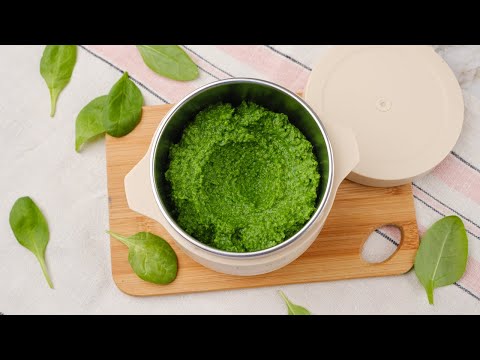
Pea Baby Food with Spinach: A Simple Recipe
Pea Baby Food with Spinach: A Fresh Serving with Potatoes and Canola Oil, with a Video. Also: when to start feeding peas, frozen vegetables, and why you shouldn't reheat spinach puree.
Contents
In short
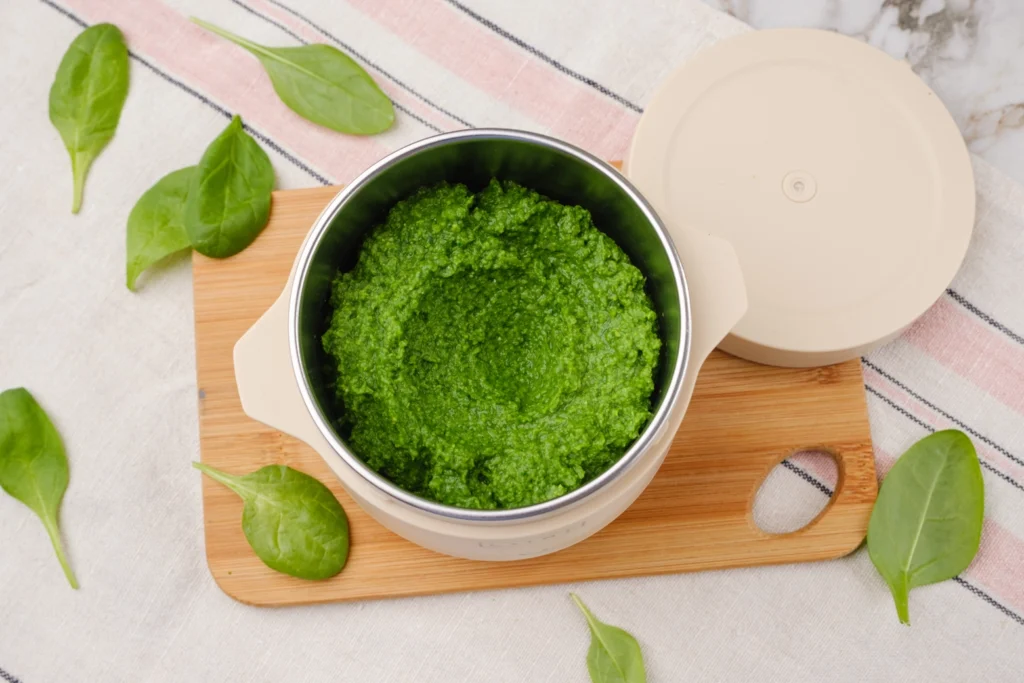
To make this pea baby food, cook the peas and potato for 10 minutes until tender, briefly cook the spinach with them, drain the cooking water, and puree everything with canola oil. Spinach is high in nitrates: Once you start introducing solid foods, you can add it to the baby food occasionally; according to the BLV, it becomes less of a concern starting at 7 months. Serve the porridge immediately after cooking; do not keep it warm or reheat it. That’s why you’re only cooking 1 serving.
Peas make the porridge mild and creamy, and spinach gives it a vibrant green color. This pea baby food follows the basic recipe from the Federal Office for Food Safety and Veterinary Affairs (BLV): 100 g vegetables, 50 g potatoes, canola oil. The potato complements the video and turns it into a complete lunch.
Recipe: Pea and Spinach Puree
- Age: preferably starting at 7 months
- Amount: 1 serving
- Prep time: 10 minutes
- Cooking time: 15 minutes
- Freezing: not recommended; eat fresh
Ingredients for 1 serving
- 50 g peas, fresh or frozen (just under 1 dl, about 6 tablespoons)
- 50 g fresh spinach leaves (2 handfuls), organic if possible
- 50 g potato (1 small), as a supplement to the video
- 1–2 teaspoons of canola oil (5–10 ml)
- 300 ml water for cooking (to be discarded)
- 3–4 tablespoons of fresh water for pureeing (45–60 ml)
Preparation
- Get ready. Wash your hands. Remove the stems, large leaf veins, and wilted leaves from the spinach, and wash it thoroughly. Peel the potato and cut it into cubes about 1 cm in size. Just use the frozen peas as is.
- Cooking: Bring the water to a boil in a small pan (saucepan). Add the potatoes and peas, cover, and cook until tender, about 10 minutes.
- Cook the spinach along with the rest of the dish. Add the spinach and let it cook for 2–3 minutes, until it wilts.
- Discard the cooking water. Pour everything into a strainer and do not reuse the cooking water. This is the BLV’s advice regarding vegetables high in nitrates.
- Puree: Puree everything until smooth with 3–4 tablespoons of fresh water. For a completely smooth puree, strain it through a fine-mesh sieve; this will leave the pea skins behind.
- Stir in the oil and serve right away. Stir in the canola oil, let the porridge cool briefly, and check the temperature with a spoon of your own. Feed him right away and throw away any leftovers.
When is it okay to start feeding a baby pea and spinach baby food? Age and Consistency
According to the BLV, you should start introducing solid foods no earlier than the beginning of the 5th month and no later than the beginning of the 7th month. To find out how to tell if your baby is ready, read the guide “Solid Foods: When and How to Start.”
- Peas: They can be added to vegetable purees once you start introducing solid foods. The British National Health Service (NHS) lists peas among the vegetables you can offer your baby when starting solids.
- Spinach: According to the BLV, it is one of the nitrate-rich vegetables, along with fennel, kohlrabi, beets, and Swiss chard. Nitrate can be converted into nitrite, which can impair oxygen supply in infants, especially during the first few months of life. In the 5. and In the 6th month, you should therefore choose low-nitrate vegetables such as carrots or squash—for example, in a squash puree with rice. You can still include spinach every now and then; according to the BLV, it’s less of a concern starting at 7 months.
- Consistency: Start by pureeing the food until it’s smooth; as the baby gets older, the puree can be coarser, according to the BLV. Then mash the peas and potatoes with a fork and finely chop the spinach.
Spinach and Peas: Tips and Variations
- Low nitrate content: According to the BLV, organic vegetables contain less nitrate than conventional ones, while greenhouse vegetables contain more than seasonal outdoor-grown vegetables. Store the spinach in a cool, dark place for a short time. Remove the stems and leaf veins because, according to the German Federal Institute for Risk Assessment (BfR), nitrates accumulate there.
- Peeling potatoes: According to the BfR, young children should only eat peeled potatoes; do not use green or sprouting ones.
- Introduce green vegetables: The NHS recommends offering less sweet vegetables, such as spinach, so your baby can get used to a variety of flavors.
Good to Know
If your child has a bacterial gastrointestinal infection, the BfR recommends that you do not give them spinach. This can lead to increased levels of nitrite in the intestines.
Variants:
- With meat or fish: Cook 10 g of lean meat (about 2 tsp), cut into small pieces, from the very beginning; according to the BLV and SGE, this should be introduced no later than the 7th month. Starting on 9 through For the 10th month, the SGE recommends 20 g. According to the BLV, the same amount of boneless salmon fillet can be used instead of meat. Cook thoroughly.
- Vegetarian with rolled oats: After draining, stir 10 g of whole-grain rolled oats into the fresh water and add 3½ tablespoons of fruit puree. According to “Gesund ins Leben,” adding more fruit juice or fruit puree increases the absorption of iron from grains and vegetables.
- Use carrots instead of spinach: Replace the spinach with 50 g of carrots—which, according to the BLV, are low in nitrates—and cook them in the dish from the start. You can cook this baby food ahead of time and freeze it, just as described in the guide “Making Your Own Baby Food.”
Storage and on the go: Spinach puree should only be eaten fresh
Pea and spinach puree isn’t the kind of puree you’d want to stock up on. According to the BLV, your baby should eat nitrate-rich vegetables immediately after they are prepared, without keeping them warm or reheating them. According to the BfR as well, spinach that has already been cooked should not be reheated, because microorganisms in it will otherwise produce more nitrite.
Attention
So don’t put the baby food in the refrigerator to save for later, don’t freeze it, and don’t take it with you in a baby food warmer or insulated container, because all of that would mean having to reheat it later. Don’t cook it until your baby is hungry. If they only eat a few spoonfuls, cook half the amount.
For outings, it’s best to make a puree with low-nitrate vegetables, such as zucchini and potato puree. Cool it down quickly, take it with you while it’s still cold, and reheat it once you get there. You can find out how to do this in the guide “Keeping Puree Warm on the Go.”
Frequently Asked Questions
At what age can babies start eating peas?
Starting when you begin introducing solid foods—that is, no earlier than the beginning of the 5th month and no later than the beginning of the 7th month. Start by pureeing the peas until they are smooth; as the baby gets older, the puree can be coarser, according to the BLV. Before the 7th month, only add spinach to the porridge every now and then.
When can my baby start eating spinach?
Starting when you begin introducing solid foods, every now and then. According to the BLV, spinach is high in nitrates; low-nitrate vegetables such as carrots or squash are better suited for a baby’s first few spoonfuls. Starting in the 7th month, spinach is less of a problem. According to the BfR, you should not give spinach to a child with a bacterial gastrointestinal infection.
Can I freeze or reheat pea and spinach puree?
No. According to the BLV, you should serve spinach porridge immediately after preparing it; do not keep it warm or reheat it. Freezing it, therefore, doesn’t make sense, because thawed porridge would have to be reheated. It’s better to cook a small portion from scratch.
Can I use frozen peas and frozen spinach?
Yes. The “Gesund ins Leben” network recommends frozen vegetables without additives as an alternative to fresh ones. It must not contain salt, cream, or spices, so creamed spinach doesn’t count. Even if you use frozen spinach, add it to the porridge while it’s fresh—don’t reheat it.
Sources
- Nutrition for Infants and Toddlers: Frequently Asked Questions, Federal Office for Food Safety and Veterinary Affairs (BLV)
- Nutrition for Infants and Toddlers: Recipes, Federal Office for Food Safety and Veterinary Affairs (BLV)
- Nutrition for Infants and Toddlers: Complementary Foods, Federal Office for Food Safety and Veterinary Affairs (BLV)
- Questions and Answers on Nitrate and Nitrite in Food, Federal Institute for Risk Assessment (BfR)
- Questions and Answers About Solanine in Potatoes (PDF), Federal Institute for Risk Assessment (BfR)
- Fact Sheet: Infant Nutrition in the First Year of Life (2024, PDF), Swiss Society for Nutrition (SGE)
- Vegetable, Potato, and Grain Porridge, “Healthy Start to Life” Network
- Infant Nutrition – Training for Health Educators (Complementary Feeding, PDF), “Gesund ins Leben” Network
- Starting at around 6 months, NHS Best Start in Life
- Hygiene Related to Infant Nutrition, kindergesundheit-info.de, Federal Institute for Public Health (BIÖG)